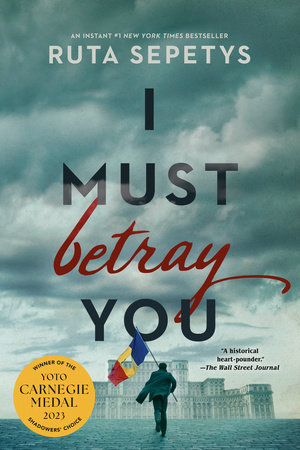
I Must Betray You
By Ruta Sepetys
YA Historical Fiction
Ages 13+, grades 7+
I Must Betray You
By Ruta Sepetys
YA Historical Fiction
Ages 13+, grades 7+
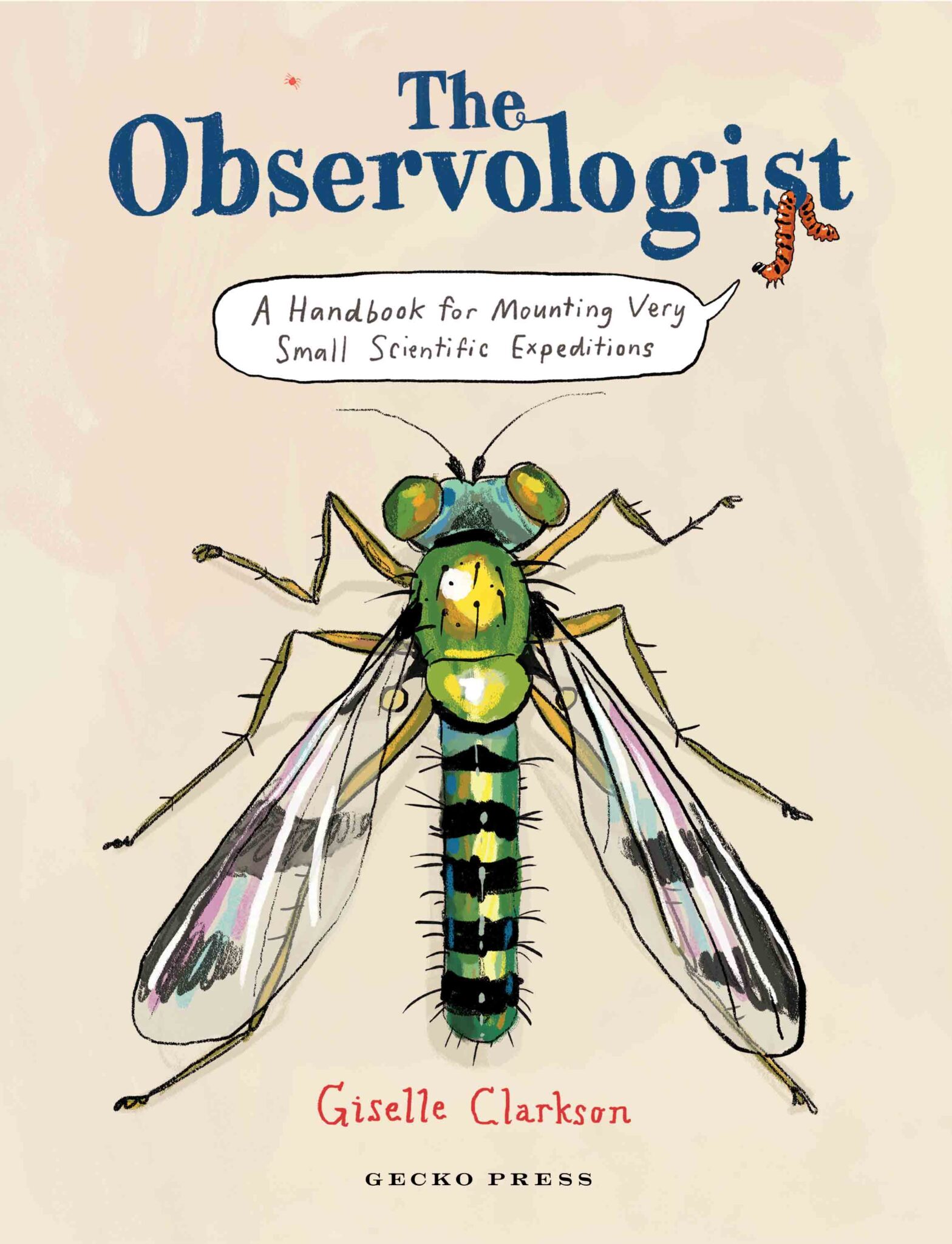
The Observologist: A handbook for mounting very small scientific expeditions
By Giselle Clarkson
Children’s Informational
Ages 8+, grades 2+
In The Observologist, Giselle Clarkson provides young readers with an engaging handbook for observing over 100 creatures and features of the natural world. With comic illustrations and detailed scientific explanations, The Observologist is an excellent read for a budding elementary naturalist.
Justification
I chose The Observologist as my children’s nonfiction book based entirely on what I could glean from the cover. “A handbook for mounting very small expeditions,” the subtitle reads, the words framed by a few choice creepy-crawlies. Though it is beyond his independent reading level, the book seemed like an excellent option to share with my nature-loving kindergartner. I anticipated a random bug fact book which my son would have readily consumed, and The Observologist does contain plenty of that. However, at its core it is a book about the habit of observing, a lovely guide for noticing the little things and finding wonder and awe, scientifically, in a variety of settings.
Content
This book introduces fairly advanced concepts for middle elementary readers in a heavily-illustrated and occasionally joke-y format. I appreciate both the comic aspect, which keeps the book entertaining, and the scientific detail and accuracy which students are apt to soak in at this age. The first chapter introduces the idea of “Observology” as a study and a practice of taking interest in little things, encouraging curiosity as a means of making life infinitely more interesting. It goes on a prime young readers with the information they will need to implement the practice: an introduction to taxonomy and scientific naming, useful instruments and invertebrate anatomy. The following four chapters guide readers through what they’ll find when they practice observology in different environments: a damp corner, pavement, a weedy patch, and inside a home.
Illustrations
With artwork that is simultaneously humorous and scientifically detailed, The Observologist holds young reader interest easily. Clarkson’s style is so directly reminiscent of Roald Dahl’s that a cameo of the Giant Peach with its insect inhabitants would not have shocked me. That aspect was sweetly nostalgic for me, and kept the book entertaining as well as interesting for my son. The somewhat-muted colors keep it from feeling too cartoony, and Clarkson includes a remarkable level of detail including such granular things as the pores on the underside of a mushroom cap and the pterostigma of a dragonfly wing. While I expected to enjoy the facts and artwork, I was pleasantly surprised by the depth of this book and will likely find a personal copy a more permanent home on our family bookshelf.
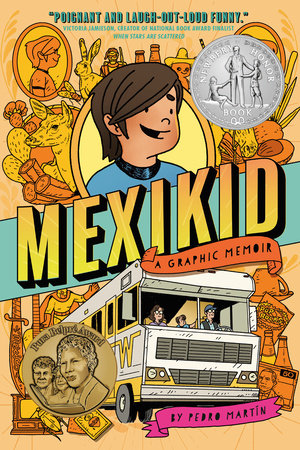
Mexikid: A Graphic Memoir
By Pedro Martín
Children’s Graphic Novel
Ages 10+, grades 5+
Summary
The year was 1977, Christmas break was approaching and Pedro Martín’s already-enormous family was preparing to welcome another member. Pedro, his parents, and eight brothers and sisters load up in an old Winnebago and a tandem pick-up truck and set off on an international roadtrip from Watsonville, California to Pegueros, Mexico to fetch their 85-year-old Abuelito (grandfather). From skipped roadside attractions, treasure hunting through K-Marts and Mexican mercados, an eventful border crossing, and visits with lots of extended and chosen family, the drive to the parents’ hometown is an adventure in itself. Once they arrive, Pedro realizes that his lineage is rich with history that he becomes eager to learn more about. In the process Pedro learns a great deal about himself, and eventually strikes a comfortable balance as an American-born Mexikid.
Justification
Graphic novels have not always been my cup of tea. I attempted popular works like Sandman and Watchmen without success, but eventually found redemptive footing with historical work like Persepolis and March, and fantasy series like Lore Olympus and Morgana and Oz. As a Newbery and Pura Belpre Honor book, I figured Mexikid held a lot of promise. Just from the cover bearing an illustrated collage of story mementos surrounding the main character, Pedro, and a Winnebago, Mexikid looked like a good time. Thankfully, I wasn’t wrong. My first thought upon picking it up from the library hold shelf was that it is an exceptionally hefty volume for a middle-grade book. Its over 300 pages are jam-packed with non-stop story and art which some might find overwhelming, but I thought it to be endlessly engaging, funny, and heartwarming.
Response
I devoured this book. Most of it was riotous, as the story includes many big personalities including that of the author, and is moved along from one lively account to the next of their comic mishaps along their journey down to Pegueros and back. It is interspersed with asides in which the reader learns about the defining characteristics and idiosyncratic traits of each family member, from sister Lila’s extreme intelligence to their Amá’s tendency to break bananas in half, thus giving us a genuine glimpse into what day-to-day life was like living among the 11 of them. It is full of family lore dating back to the Mexican Revolution, and Martín showcases his adaptable abilities as an artist by illustrating those segments in an entirely different style from the rest of the book. Woven in with the humorous tales and poop and snot jokes appropriate for a 10-year-old protagonist are bits of lovely explanation and appreciation of Mexican culture, as well as moments of sweet, thoughtful, sometimes even somber realization through which young Pedro begins to come of age. I found it just as enjoyable as some adult books of a similar genre, and could see it being a fun read together with a younger reader as some dated pop culture references may benefit from explanation (cassette players and the Fonz from Happy Days, for instance). I find myself genuinely excited for the day my son is old enough to enjoy this book, and that’s one of the biggest compliments I can offer.
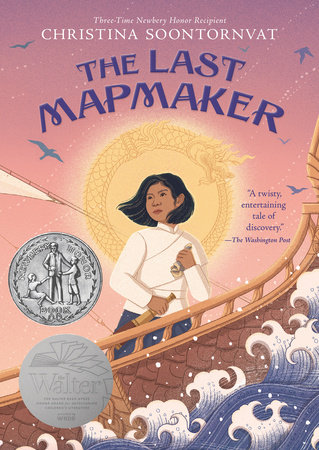
By Christina Soontornvat
Newbery Honor 2023
Ages 8+, grades 3+
Summary
By day, Sai does her best to present as 12-year-old with potential in the capital city of Mangkon. By night, she hides her meager earnings and proper uniform in a tree while dodging pickpockets and drunks– including her own father– in the lowliest part of town. “The Tail is the Teeth” is the saying there; the beginning is the end, the path behind and the path ahead are one and the same, and she is limited by her lack of lineage. Sai has a knack for handwriting and an eagerness to learn, which make her an excellent candidate when she falls into the position of assistant to the renowned master mapmaker Paiyoon.
When Paiyoon gains a seat on an expedition to map new southern territory, Sai jumps at the chance to join him and escape her dead-end life. During the months-long journey at sea, she perfects both her forgery and mapmaking skills and develops new relationships which she must navigate carefully, so that her true history and lineage is not brought to light, all while she yearns for stability and connection. The perils grow and Sai is faced with increasingly consequential choices that, in the end, lead her back to herself. The Tail may be the Teeth, but Sai determinedly gnaws through the social blockades to forge her own path to family and freedom.
Justification
The Last Mapmaker has been on my list since I saw it on the awards shelf at our local library branch, but I rarely make time to read YA, especially middle-grade literature as my reading time is precious and limited. However, I was happy to have the excuse of reviewing it to finally dive in to the world Christina Soontornvat creates in this novel. At its heart, this is a coming-of-age story of a girl desperate to forge a different path than the one made available to her. The novel also includes themes of complicated family dynamics, boundaries, and forgiveness; imperialism and the cultural and environmental costs of colonialization; and a responsibility to learn from past mistakes and do better for future generations. I love this novel for digging into such mature themes in ways that are appropriate and accessible to young readers and am impressed with Soontornvat’s ability to do so in a way that is not heavy handed and emphasizes the fantasy and adventure of the story while presenting important ethical dilemmas for the reader's consideration.
Response
Beyond the ethics, this is also just a good fantasy novel. It has high adventure, mythology, danger, betrayal, and even a dragon or two, all experienced by realistic characters who are both likeable and imperfect, and who learn and grow as the story goes. As a main character Sai is mature for her age, but one would have to become street-savvy in the life she has lived. She is determined and compelling, and grapples with her own morals through each decision she makes. I am glad that The Last Mapmaker lived up to my own long-awaited expectations for it, and that such authors like Soontornvat are setting such high standards in fiction for today’s youth.
Soontornvat, C. (2022). The last mapmaker. Candlewick Press.
Pardalita
By Joana Estrela, translated by Lyn-Miller Lachmann
YALSA Great Graphic Novels for Teens
Ages 12+, grades 7+
Summary
Raquel lives a fairly straightforward life in a small Portuguese town. She is 16, she goes to school, spends time with her two best friends Luisa and Fred, and teaches her divorced mother how to navigate the internet. One day, a girl catches her attention and something in her shifts. “I feel weird when I see you,” Raquel reflects. “Maybe I envy you.” When Fred decides to audition for the theater troupe in which Raquel’s person of interest, Pardalita, is involved, she is unexpectedly pulled in as well. Through simple, daily ruminations, Raquel grapples with her feelings and her identity. The standard insecurities of teenage life, the relief of a breakup with a sweet but mismatched boyfriend, and the comfort of her long-time friends provide the backdrop to the confusing but quietly titillating development of her new friendship, and she begins to wonder what she can’t fully bring herself to say. “How does a person know they are? / Is there a test?” she ponders over her unspoken sexuality. “Because I can’t be the only one / who is / here / now. / And what if?”
Justification
Pardalita came to my attention through the YALSA Great Graphic Novels list. The two-tone artwork immediately brought to mind another of my favorite graphic novels, Persepolis by Marjane Satrapi. I was also excited to see the LGBTQ themes represented, and was drawn in by the understated snippets of text I was able to preview. “Understated” may be one of the most accurate ways to describe the book. The story is a low-key slice of life peppered with flashbacks, told through a combination of lyrical prose, comic-style strips, vignettes of mundane reflections, and scratchy illustrations. Contrary to what one might expect from this constant shift in format, the story flows beautifully and closes with an abrupt but appropriately simple ending.
Response
I can imagine this book may not be everyone’s cup of tea– no book is. The mix of styles between poetry, stream of consciousness, and graphic novel may turn some away; however, I appreciated how quietly engaging it is and found that the shifts in format added to the storytelling, giving me a greater clue to Raquel’s state of mind at any given point in the story. As a slow-burn teen lesbian awakening story, I think it’s an excellent book for LGBTQ representation, as it lacks any overt language or plot that is likely to be challenged and focuses almost solely on Raquel’s internal experience. With little actual drama but lots of very personal and relatable introspection, I found it to be powerfully contemplative in its simplicity. This made Pardalita a comforting and easy, but very worthwhile read.
Estrela, J. (2023). Pardalita (L. Lachmann, Trans.). Levine Querido.
Memoirs of a Tortoise
By Gabi Snyder, ill. Samantha Cotterill
Texas 2x2 Award
Ages 4+, grades PK+
In Look, a parent and child meander through an autumn day, from breakfast to a market trip, a walk through town and back home. As they go, the child and reader are encouraged to “look.” to tune into their surroundings by sight and find a sense of mindfulness by identifying patterns.
Justification
This book’s layered illustrations drew me in, along with its themes of mindfulness. I am often turned off by the simplicity of some concept books, perhaps to the deficit of my preschooler. While Look provides persistent guidance and practice in pattern recognition, it also offers so much more with text in verse, an engaging visual narrative, and mindfulness practices made approachable for even the youngest audience.
Content
Gabi Snyder’s text is sweet and lyrical. The first page sets the tone for the duality of this book, introducing the idea of pattern recognition, along with the idea that the world can feel big and overwhelming to the intended audience of the book– preschoolers through early elementary readers. She begins: “We are in this VAST world. / And the world is all around– / filled with colors and shapes and sizes./ It can be a lot to take in.” With a down-to-earth charm, Snyder’s text guides readers to slow down and pay attention to their surroundings, finding patterns in unexpected places. She also gently acknowledges how the big world can be confusing and feel like too much, and uses pattern recognition as a grounding tool to turn to in those times.
Illustrations
While Snyder’s text provides the concepts, Samantha Cotterill’s stratified illustrations offer the narrative of parent and child as they move through their day and run errands, find patterns, and appreciate their surroundings. There is so much to find in her busy, vibrant scenes that something new can be found on every read through– I can vouch for this as it became my two-year-old’s favorite for a solid two weeks. Cotterill’s works showcases not only a variety of environmental patterns, but also scenes of shared joy and warmth between the two main characters, culminating in a final nighttime vignette accompanying the comforting closing text, “And the words / I love you. / I love you. / I love you – / a pattern of love, / consistent and sure.”
Snyder, G. (2024). Look, (S. Cotterill, Illus.). Simon & Schuster.
The Firekeeper’s Daughter
By Angeline Boulley
Walter Award Winner
Ages 14+, grades 9+
Summary
Daunis Fontaine is fresh out of high school and enjoying her last summer before jumping into the university-to-med-school pipeline. Hers hasn’t been an easy road: she’s a biracial anishinaabekwe-- half-Ojibwe woman-- and though she identifies with her native roots and family, she remains an unregistered tribal member due to the scandal surrounding her birth and her father’s death a few years later. More recently her maternal uncle died under mysterious circumstances and her grandmother had a stroke, leaving her single mother the fragile care-taker of a family legacy. These circumstances already have Daunis conflicted about leaving when she meets Jamie, the charming new recruit for her brother’s hockey team. However, deaths begin to pile up around her and she learns there is more to Jamie than she bargained for. Daunis is recruited to help expose a new ring of corruption and drug manufacturing within her community, and in doing so may clarify the circumstance of her uncle’s death. But the opportunity comes with a level of risk and secrecy that Daunis isn’t sure she can navigate within the bounds of her own ethics and commitment to her community.
Justification
I was initially drawn to this book by its breathtaking cover art by Ojibwe artist Moses Lunham. It beautifully reflects Daunis’ internal struggle with her biracial identity through the mirrored face of a native woman, surrounded by indigenous design. The summary called to mind another much older work of Native American YA literature, Monkey Beach, that I enjoyed immensely both for its representation of a culture I am largely unfamiliar with, and for the themes of mysticism therein. Similar themes exist within The Firekeeper’s Daughter, however, they are presented alongside stronger themes of tradition, community, and belonging, as well as darker themes of racism, drug use and addiction, rape, and death. This makes for a more complex, albeit sometimes harder to believe, story than I remember in Monkey Beach, but one that nonetheless offers an engaging and suspenseful narrative within a setting grounded in truth as Angeline Boulley draws on her own Ojibwe upbringing in the story’s site of Sault St. Marie, Michigan.
Response
From the get-go, I appreciated the character of Daunis - she is brilliant-minded and strong (she is described as nearly six feet tall and athletically built), while also showing all the social uncertainties and occasional lapses of logic and judgement appropriate of an 18-year-old in a time of transition. The dialogue feels natural, and shifts appropriately based on the relationship between each set of characters. It is full of dialectical patterns and cultural quirks that Boulley gets to explore from both the Ojibwe and non-indigenous perspectives, as Daunis explores and embraces both parts of herself. I also found it impossible to not relish in the vivid descriptions of Ojibwe culture. The clothing, prayers, music, food, and traditional beliefs presented in the story are described beautifully, conveying a consistent sense of deep meaning and sacredness. Finally, I love that it all tied together into an overarching theme of multigenerational wisdom, support, and belonging alongside that of forging one’s own path in truth.
Boulley, A. (2021). The Firekeeper’s daughter. Henry Holt.
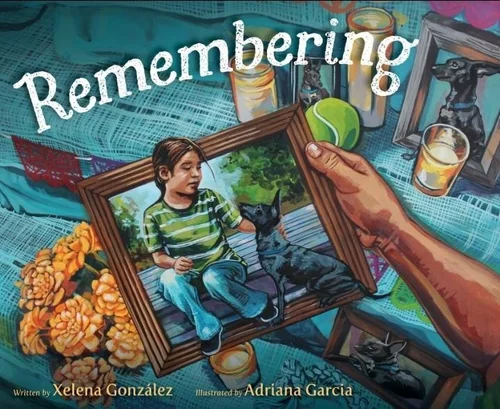
In Remembering, a family reflects on the life of their deceased dog. With poignant text and vibrant illustrations, the story follows a young narrator through their grief, love, and celebration.
Justificiation
I chose this book from the Pura Belpre Honors list because it reminded me of another children’s book, An Ofrenda for Perro, which is a favorite for our family every fall. The stories are similar in that they depict young children navigating the loss of their pets and finding closure through the Latine tradition of building ofrendas, or altars, for Dia de los Muertos to celebrate the lives of departed loved ones. An Ofrenda for Perro helped me and my young children through the loss of our own dog, and Remembering certainly presents the same affective power.
Content
The text, which originated as a poem by author Xelena González, is lyrical and tender. It portrays the sorrow of losing a pet in ways that resonate with adults, but still manages to be entirely accessible to young children. Anyone who has loved and lost a furry family member can relate to the emptiness left by their passing, and she captures that in lines like “The house seems empty without you here / So our family fills it with photos and stories until we feel like you are near.” In addition to the poem itself, both the author and illustrator provide strikingly honest notes at the end about the personal experiences that shaped their work on this book. Finally, González offers readers guidance for building their own ofrenda at home. In a time when we see deep division between groups of people, this lovely gesture serves to unite readers by inviting them to share in a meaningful cultural tradition.
Illustration
While the text stands beautifully cathartic on its own and earned significant recognition including School Library Journal Best Books of the Year, Tomás Rivera Mexican American Children's Book Award Nominee, Kirkus Best Picture Books of the Year, and Ezra Jack Keats Finalist; Remembering received the Pura Belpre Honor for its illustrations. Artist Adriana M. Garcia works primarily in murals, and her style carries over into her illustrations as well. The layers of rich color that might appear to blend together smoothly on the side of a building bring depth and texture to her work on the page. I especially love that the dog seems to come alive in each image, stretching beyond the framed pictures through the magic of the young narrator’s memories. Garcia’s lush saturation and dynamic strokes lend an appropriate otherworldliness to her down-to-earth scenes and to González’s story of the family grieving, reminiscing, and celebrating.
González, X. (2023). Remembering (A. Garcia, Illus.). Simon & Schuster.
Iveliz Explains It All
by Andrea Beatriz Arango Novel in Verse Ages 10+, grades 5+ Newberry Honor Book 2023
Summary
Iveliz has become known as both troubled and a trouble-maker, but she is determined to turn things around this year. This bilingual novel-in-verse, presented in diary format, follows the titular character through her seventh-grade school year as she faces the standard junior high obstacles of bullies, school drama, and self-consciousness, as well as some less-standard but incredibly genuine challenges of grief and loss, changing family dynamics, and PTSD. Through one-sided conversations with her journal, Iveliz navigates her own mental illness, that of her grandmother Mimi who moves in with them from Puerto Rico, and discovers what it means to have-- and to be-- a good friend. She eventually learns to speak her truth and advocate for herself, and also to really listen to the voices of those she holds most dear.
Justification
Iveliz Explains It All is formatted as a novel-in-verse, and was a Newberry Honor Book in 2023. I chose this book in part because of its accolades, part because of its reading level (I am seeking more exposure to middle-grade YA literature), and part because it is bilingual. As a bilingual mother of two little kids, we read a lot of bilingual children’s literature in my attempt to ingrain some of that linguistic fluidity in them. Iveliz Explains It All piqued that personal interest, and offers exemplary code-meshing of English and Spanish throughout the book. Arango weaves the two languages through the story with remarkable ease, often offering contextual hints and explanations instead of direct translations for English-only readers to navigate the Spanish text. This maintains a natural rhythm and pace of the writing even when rapidly switching back and forth.
Response
In this debut novel Arango tackles several hard-hitting topics: race, identity, immigration, grief, loss of a parent, generational trauma, mental illness and related stigma to name a few. She does so with notable grace; while some themes are more important to the overall plot than others, none feel as if they get swept under the rug and all are presented as formative parts of Iveliz’s experience. Even with the subject depth, there is also an entertaining air of angsty, awkward humor in the voice of the 12-year-old protagonist. At moments, the two combine to hit a cultural nail directly on the head, like when she becomes understandably irate at the ongoing mispronunciation of her name and that of her best friend, Amir: “Like, hello? / How hard is it to ask kids what they want to be called, / and then learn it?” The book is printed in a handwriting-style font on a notepaper background to evoke the feel of a diary. As an aspiring slam poet Iveliz subscribes to free verse, and responds to her father’s good-natured jeering with “Plus, I’ve read books in verse. / He can’t trick me– / I know there aren’t any rules when it’s a journal / just like there aren’t any rules / when Safia Elhillo or Sarah Kay / Or Mahogany L. Browne steps onstage.” In addition to its occasionally lyrical entries, there are bulleted lists and sketchy illustrations that feel true to pre-teen journal doodles. This approachable story illustrates major struggles in a pre-teen context, as well as the process of learning to manage those struggles with healthy coping mechanisms, honest communication, forgiveness, and the support of loving family and friends.
Arango, A.B. (2022). Iveliz explains it all (A. Bermudez, Illus). Penguin Random House.