Friday, November 21, 2025

Home by Isabelle Simler, translated by Vineet Lal

Home


By Isabelle Simler, translated by Vineet Lal
Children’s Poetry
Ages 5+, grades 2+

Home by Isabelle Simler is a children’s book of poetry in which each of the 27 poems introduces a different animal and describes the nature and function of their home. The free verse poetry is accompanied by Simler’s ink illustrations depicting the animals in their environments.

Justification
Home was chosen from a selection of children’s poetry books by my animal-loving son. Simler’s coverage of not only a wide selection of animals but their dwellings in their environments and their geographic locations was a multilayered win for my nature-curious kindergartner. The illustrations are striking as well, and I’ve been surprised at how engrossed he is in the poetry itself.

Content
Simler is an author and illustrator living in Paris, so the original work, Maison, was published in French. That version won numerous awards in 2022 and 2023, while its English counterpart was named a Batchelder Honor Book and made the ALSC Notable Children's Books List and the Cooperative Children's Book Center Choice List this year. This version is translated by Vineet Lal and while I can’t speak to how true it is to Simler’s original prose, I can attest to the beauty of Lal’s interpretation. The text is not as lyrical as some free verse poetry, but is engaging thanks in part to its descriptive imagery and, most especially, its first-person perspective. Simler’s introductory text addresses this beautifully, saying “To explore these unique places, I’ve had to bend, and shrink, and squeeze, and let myself be transformed in weird and wonderful ways.” Additionally, the last four pages consist of additional amazing facts about each animal, a useful glossary of terms, and additional recommended resources for inspired readers to continue their exploration of this topic.

Illustrations
Simler's illustrations are interesting. She works primarily in ink, and her individually discernable strokes bring a liveliness to each image. They are incredibly detailed without being overwhelming, realistic without feeling scientific or boring. Many include a variety of bright colored strokes against a dark background, creating a depth to each image that is unusual in children’s illustration. Each one feels like an intimate view of the animal subject, and sublimely compliments her first-person prose.

Simler, I. (2024). Home (V. Lal, Trans.). Eerdman’s Books for Young Readers.
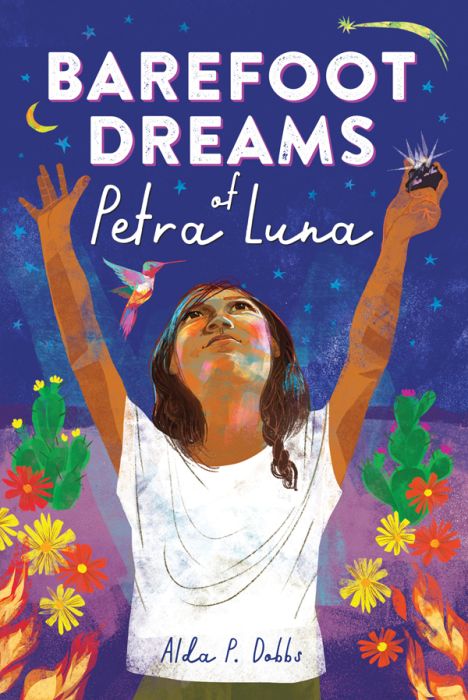
The Barefoot Dreams of Petra Luna


By Alda P. Dobbs
Children's Historical Fiction
Ages 8+, grades 4+

Summary
In The Barefoot Dreams of Petra Luna, Petra flees her home with her younger sister, baby brother, and grandmother as their village is burned to the ground during the Mexican Revolution. This family is all she has left - her mother died giving birth to her brother, and her father was conscripted unwillingly into the Federal Army. However, she has dreams– of living peacefully, of going to school and learning to read, and of reuniting with their father on the other side of the war. She is willing to cross deserts, battlefields, and national boundaries with her remaining family in tow to make that happen.

Justification
The Barefoot Dreams of Petra Luna has been on my radar since it reached library shelves. In addition to being historical fiction (my favorite genre) set in Mexico (a personal interest), it received numerous honors and awards in 2022 including the Pura Belpré Honor, Américas Honor, and making the New York Public Library Best Books list. This age range is challenging for me, as it’s not always engaging enough to hold my attention like some YA literature and my own kids are still too young for me to share it with them. However, The Barefoot Dreams of Petra Luna and its sequel, The Other Side of the River, will remain on our shelves until they are old enough for us to appreciate them together. Alda P. Dobbs’ story of Petra and her family’s struggle through the revolution in her home country and as refugee immigrants in the United States is an important one for children to experience, especially as the topic of immigration remains so divided.
 
Response
My first thought reflecting on this book is how grim the story is overall. While I am sure it is true to the experience at that time (it is a fictionalized account of Dobb’s great grandmother’s journey into America), I was struck at how harsh and unrelenting it is for a book geared toward such a young audience. However it is quite fast paced, and the ongoing action mixed with Petra’s persistent hope keeps the story moving and the reader engaged enough to stay with it. I always appreciate a book that incorporates the language of its non-English-speaking characters, and Dobbs does this really well, in a way that presents Spanish terms often in dialogue and offers their translation smoothly as part of the story thereafter. The linguistic explanations are more obvious that I often see or prefer in YA or adult literature, but that makes it very accessible to a younger audience that might otherwise get hung up on unknown vocabulary. While The Barefoot Dreams of Petra Luna may not have been my top book of this year, it is a worthwhile read and I recommend it for the perspective the story offers, and the history lesson therein. 

Dobbs, A. (2021). The barefoot dreams of Petra Luna. Sourcebooks Young Readers.

Wednesday, November 19, 2025

Everything Sad is Untrue by Daniel Nayeri

Everything Sad is Untrue

By Daniel Nayeri
Printz Award Winner
Ages 10+, grades 6+

Summary
In an American classroom, Daniel (whose name is really Khosrou, but that has proven too hard for Americans to pronounce) stands in front of his class recounting tales of his life, of his family, and of the place he grew up and later fled. Addressing the reader directly, he claims that “the shame of refugees is that we have to constantly explain ourselves. It makes the stories patchworks, not beautiful rugs.” This largely sums up the book, as his stories are constantly punctuated by his having to stop and clarify some aspect of Persian life to either his classmates or the reader. Yet his stories are beautiful, as accounts of his early life and immigration to America are intricately woven into Persian history and mythology.

Born in Iran to a family of wealth and Islamic legacy, Daniel now lives with his mother, older sister, and sometimes-stepdad in Edmond, Oklahoma, and spends his time observing and notating the behavior of his American peers in sometimes clumsy, sometimes astute attempts at assimilation. This linear story of Everything Sad is Untrue covers just a school year, but through his storytelling he shares generations’ and centuries’ worth of history and lore. His audience of skeptical peers mostly believes him to be the poor refugee kid who makes things up for attention, but for Daniel, his stories are how he makes sense of the world and connects his patchwork of memories to his present life. 

Justification
I was attracted to this book from the Printz Award list because of its topic. I have been on a kick of reading and listening to Middle Eastern historical fiction for much of the past year, beginning with Gian Sardar’s Take What You Can Carry and Renee Adieh’s The Wrath and the Dawn, continuing through the work of Marjan Kamali. Everything Sad is Untrue offers an excellent continuation of this theme but from a totally new viewpoint from author Daniel Nayeri (the character’s name is no coincidence; though the work is considered fiction it is largely autobiographical). Like other related works, Nayeri includes explanations of Middle Eastern social expectations and formalities, as well as my favorite part: rich descriptions of Persian cuisine like chicken fesenjoon, cardamom pistachio cake, and saffron rosewater cookies. The experience of Iran– its beauty and rich culture as well as its problematic political history– through the eyes of a twelve-year-old boy brought something new I didn’t know I needed to round out this literary fixation. 

Response
I was shocked when I realized the suggested age range for this book started at ten years, not because of anything glaringly inappropriate, but because the book engaged me nearly as much as any YA or adult fiction has. Nayeri manages to write in a voice that is simultaneously true to the 12-year-old narrator, yet also seamlessly wise well beyond his years. Alongside scenes of pre-teen social angst and poop jokes– lots of actually pretty funny poop jokes– he stitches recollections of familial fables and vignettes of deeply meaningful struggle and insight. I’m not embarrassed to admit the latter had me nodding along teary-eyed on more than one occasion, like when he describes his unsuccessful attempts to share memories of their previous life with his older sister. “Sometimes,” Daniel says, “you just want somebody to look at a thing with you and say, “Yes. That is a thing you’re looking at. You haven’t lied to yourself.” Nayeri’s ability to give weight to both Daniel’s attempts at learning to eliminate in American toilets, as well as to his deep desire for connection to himself and his family, make this book a remarkable piece of literary work for both youth and adult readers.

Nayeri, D. (2020). Everything sad is untrue. Levine Querido.

Wednesday, November 12, 2025

Pardalita

By Joana Estrela, translated by Lyn-Miller Lachmann

YALSA Great Graphic Novels for Teens

Ages 12+, grades 7+


Summary

Raquel lives a fairly straightforward life in a small Portuguese town. She is 16, she goes to school, spends time with her two best friends Luisa and Fred, and teaches her divorced mother how to navigate the internet. One day, a girl catches her attention and something in her shifts. “I feel weird when I see you,” Raquel reflects. “Maybe I envy you.” When Fred decides to audition for the theater troupe in which Raquel’s person of interest, Pardalita, is involved, she is unexpectedly pulled in as well. Through simple, daily ruminations, Raquel grapples with her feelings and her identity. The standard insecurities of teenage life, the relief of a breakup with a sweet but mismatched boyfriend, and the comfort of her long-time friends provide the backdrop to the confusing but quietly titillating development of her new friendship, and she begins to wonder what she can’t fully bring herself to say. “How does a person know they are? / Is there a test?” she ponders over her unspoken sexuality. “Because I can’t be the only one / who is / here / now. / And what if?” 

Justification

Pardalita came to my attention through the YALSA Great Graphic Novels list. The two-tone artwork immediately brought to mind another of my favorite graphic novels, Persepolis by Marjane Satrapi. I was also excited to see the LGBTQ themes represented, and was drawn in by the understated snippets of text I was able to preview. “Understated” may be one of the most accurate ways to describe the book. The story is a low-key slice of life peppered with flashbacks, told through a combination of lyrical prose, comic-style strips, vignettes of mundane reflections, and scratchy illustrations. Contrary to what one might expect from this constant shift in format, the story flows beautifully and closes with an abrupt but appropriately simple ending.

Response

I can imagine this book may not be everyone’s cup of tea– no book is. The mix of styles between poetry, stream of consciousness, and graphic novel may turn some away; however, I appreciated how quietly engaging it is and found that the shifts in format added to the storytelling, giving me a greater clue to Raquel’s state of mind at any given point in the story. As a slow-burn teen lesbian awakening story, I think it’s an excellent book for LGBTQ representation, as it lacks any overt language or plot that is likely to be challenged and focuses almost solely on Raquel’s internal experience. With little actual drama but lots of very personal and relatable introspection, I found it to be powerfully contemplative in its simplicity. This made Pardalita a comforting and easy, but very worthwhile read. 


Estrela, J. (2023). Pardalita (L. Lachmann, Trans.). Levine Querido.


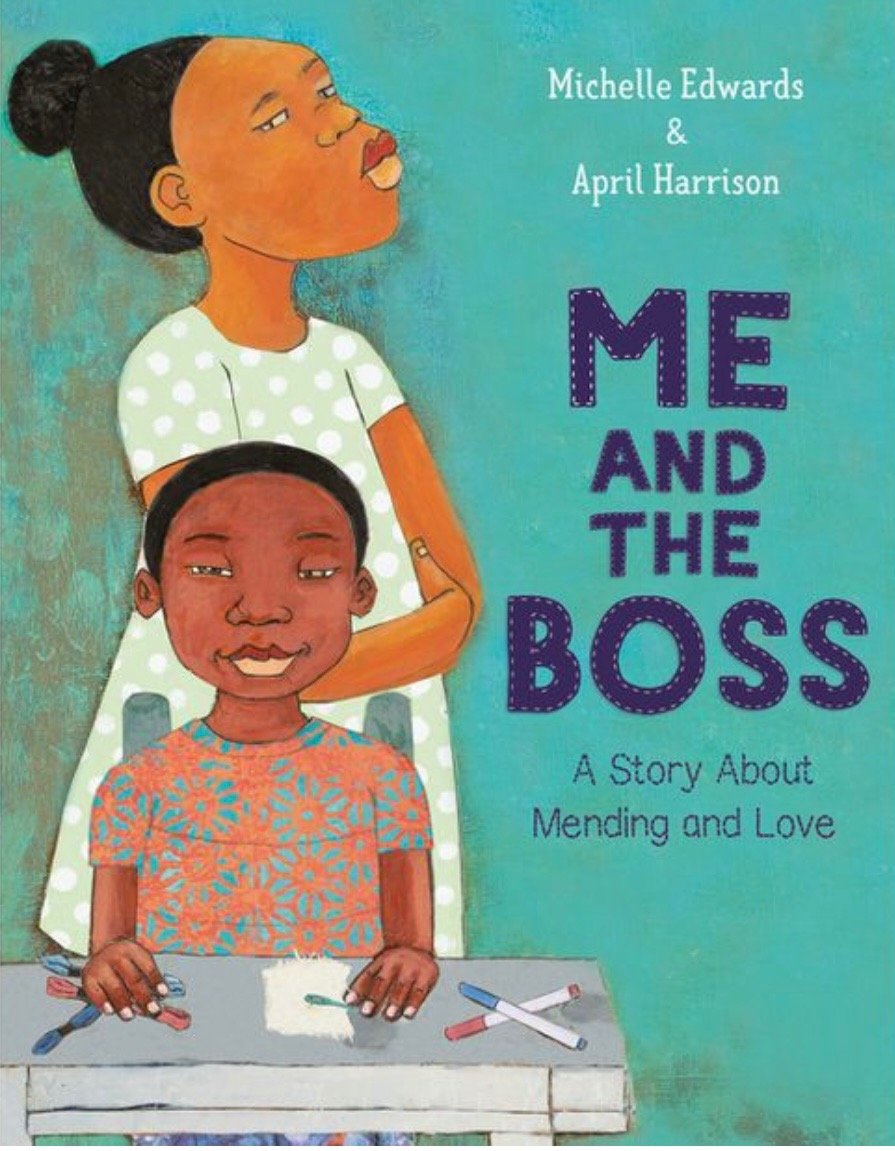
Me and The Boss: A Story About Mending and Love by Michelle Edwards, illustrated by April Harrison

Me and The Boss

By Michelle Edwards, illustrated by April Harrison
Coretta Scott King Honor Book
Ages 4+, grades PK+

In Me and The Boss, six-year-old Lee follows the lead of his big sister, Zora. In a trip to their library, the two learn a new skill together. Though Zora excels immediately and Lee struggles at first, he continues to practice and, later, thoughtfully employs his new skill to mend his sister’s bear.

Justification
Me and The Boss was a mostly random pick from the Coretta Scott King honors list. The striking cover art by illustrator April Harrison caught my attention, and I erroneously assumed from the subtitle, A Story About Mending and Love, that the characters might experience a rupture and repair in their narrative. As a mom of two often-quarelling young siblings, I love a good story about making mistakes and making amends. While this story is not that– it is about literal mending, as Lee and Zora are introduced to the skill of needlework in their trip to the library– it is a sweet story about the dynamic of siblings and the ways they may show their love for one another.

Content
Michelle Edward’s text is straightforward and very accessible for younger readers/listeners. The story is narrated in first person by Lee, and while some adult readers might find the wording a bit clunky at times, I can see two things at work here: diverse cultural and dialectical influences (as Lee and his family are Black), and quirky uses of language consistent with the way a six-year-old may actually describe his experiences. For example, when Lee is up late practicing his stitching, he says: “With my needle, I poke a stitch and snag my hurt finger. I quick brave another. That tiger’s tooth, mean and sharp, catches me again. Take your time, Lee.” I appreciate this aspect of the story, and think it lends the book character and gives us a greater glimpse into how Lee thinks. I also appreciate that, while the storyline is quite simple and takes place in less than 24 hours,the understanding we gain of Lee and Zora’s relationship far surpasses the single day. Zora is the boss, the leader who doles out instructions and enforces rules, and Lee is the younger, not-yet-so-confident tag-a-long. However, Zora isn’t painted as plainly bossy; she uses her confidence to advocate for her brother and keep them both safe. While Lee’s gesture of repairing Zora’s bear doesn’t change their relationship, it doesn’t have to– it brings them to a tender moment in which Zora wraps him in a grateful hug and, as Lee explains, “we share something that is bigger than my pocket, bigger than Bess’s ear, maybe even bigger than me or Zora.”

Illustrations
Harrison’s illustrations are engrossing. She works in collage and mixed-media painting, so on every read-through you’re likely to catch something new in her images. The layers of bright, sometime clashing patterns and colors keep readers’ attention, and also lend a sense of familiarity to each scene, like yes, this plaid came from a real men’s button-up shirt and yes, a real-life Zora would likely wear that checkerboard skirt with a bright batik blouse. Me and The Boss isn’t Harrison’s first award-winning work; her very first children’s book, What is Given from the Heart, won the John Steptoe Award New Talent. Her style in this book compliments the simplicity of Edwards story while offering a colorful depth in this view of a day in the life of these two siblings.

Edwards, M. (2022). Me and the boss (A. Harrison, Illus.). Anne Schwartz Books.