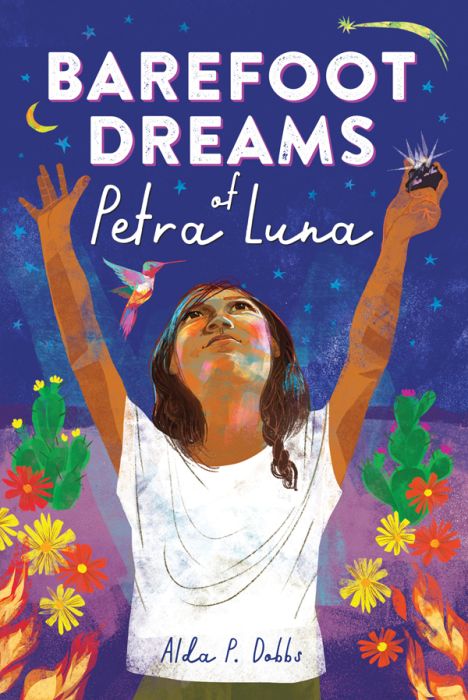
By Alda P. Dobbs
Children's Historical Fiction
Ages 8+, grades 4+
Children's Historical Fiction
Ages 8+, grades 4+
Summary
In The Barefoot Dreams of Petra Luna, Petra flees her home with her younger sister, baby brother, and grandmother as their village is burned to the ground during the Mexican Revolution. This family is all she has left - her mother died giving birth to her brother, and her father was conscripted unwillingly into the Federal Army. However, she has dreams– of living peacefully, of going to school and learning to read, and of reuniting with their father on the other side of the war. She is willing to cross deserts, battlefields, and national boundaries with her remaining family in tow to make that happen.
In The Barefoot Dreams of Petra Luna, Petra flees her home with her younger sister, baby brother, and grandmother as their village is burned to the ground during the Mexican Revolution. This family is all she has left - her mother died giving birth to her brother, and her father was conscripted unwillingly into the Federal Army. However, she has dreams– of living peacefully, of going to school and learning to read, and of reuniting with their father on the other side of the war. She is willing to cross deserts, battlefields, and national boundaries with her remaining family in tow to make that happen.
Justification
The Barefoot Dreams of Petra Luna has been on my radar since it reached library shelves. In addition to being historical fiction (my favorite genre) set in Mexico (a personal interest), it received numerous honors and awards in 2022 including the Pura Belpré Honor, Américas Honor, and making the New York Public Library Best Books list. This age range is challenging for me, as it’s not always engaging enough to hold my attention like some YA literature and my own kids are still too young for me to share it with them. However, The Barefoot Dreams of Petra Luna and its sequel, The Other Side of the River, will remain on our shelves until they are old enough for us to appreciate them together. Alda P. Dobbs’ story of Petra and her family’s struggle through the revolution in her home country and as refugee immigrants in the United States is an important one for children to experience, especially as the topic of immigration remains so divided.
Response
My first thought reflecting on this book is how grim the story is overall. While I am sure it is true to the experience at that time (it is a fictionalized account of Dobb’s great grandmother’s journey into America), I was struck at how harsh and unrelenting it is for a book geared toward such a young audience. However it is quite fast paced, and the ongoing action mixed with Petra’s persistent hope keeps the story moving and the reader engaged enough to stay with it. I always appreciate a book that incorporates the language of its non-English-speaking characters, and Dobbs does this really well, in a way that presents Spanish terms often in dialogue and offers their translation smoothly as part of the story thereafter. The linguistic explanations are more obvious that I often see or prefer in YA or adult literature, but that makes it very accessible to a younger audience that might otherwise get hung up on unknown vocabulary. While The Barefoot Dreams of Petra Luna may not have been my top book of this year, it is a worthwhile read and I recommend it for the perspective the story offers, and the history lesson therein.
The Barefoot Dreams of Petra Luna has been on my radar since it reached library shelves. In addition to being historical fiction (my favorite genre) set in Mexico (a personal interest), it received numerous honors and awards in 2022 including the Pura Belpré Honor, Américas Honor, and making the New York Public Library Best Books list. This age range is challenging for me, as it’s not always engaging enough to hold my attention like some YA literature and my own kids are still too young for me to share it with them. However, The Barefoot Dreams of Petra Luna and its sequel, The Other Side of the River, will remain on our shelves until they are old enough for us to appreciate them together. Alda P. Dobbs’ story of Petra and her family’s struggle through the revolution in her home country and as refugee immigrants in the United States is an important one for children to experience, especially as the topic of immigration remains so divided.
Response
My first thought reflecting on this book is how grim the story is overall. While I am sure it is true to the experience at that time (it is a fictionalized account of Dobb’s great grandmother’s journey into America), I was struck at how harsh and unrelenting it is for a book geared toward such a young audience. However it is quite fast paced, and the ongoing action mixed with Petra’s persistent hope keeps the story moving and the reader engaged enough to stay with it. I always appreciate a book that incorporates the language of its non-English-speaking characters, and Dobbs does this really well, in a way that presents Spanish terms often in dialogue and offers their translation smoothly as part of the story thereafter. The linguistic explanations are more obvious that I often see or prefer in YA or adult literature, but that makes it very accessible to a younger audience that might otherwise get hung up on unknown vocabulary. While The Barefoot Dreams of Petra Luna may not have been my top book of this year, it is a worthwhile read and I recommend it for the perspective the story offers, and the history lesson therein.
Dobbs, A. (2021). The barefoot dreams of Petra Luna. Sourcebooks Young Readers.

No comments:
Post a Comment